
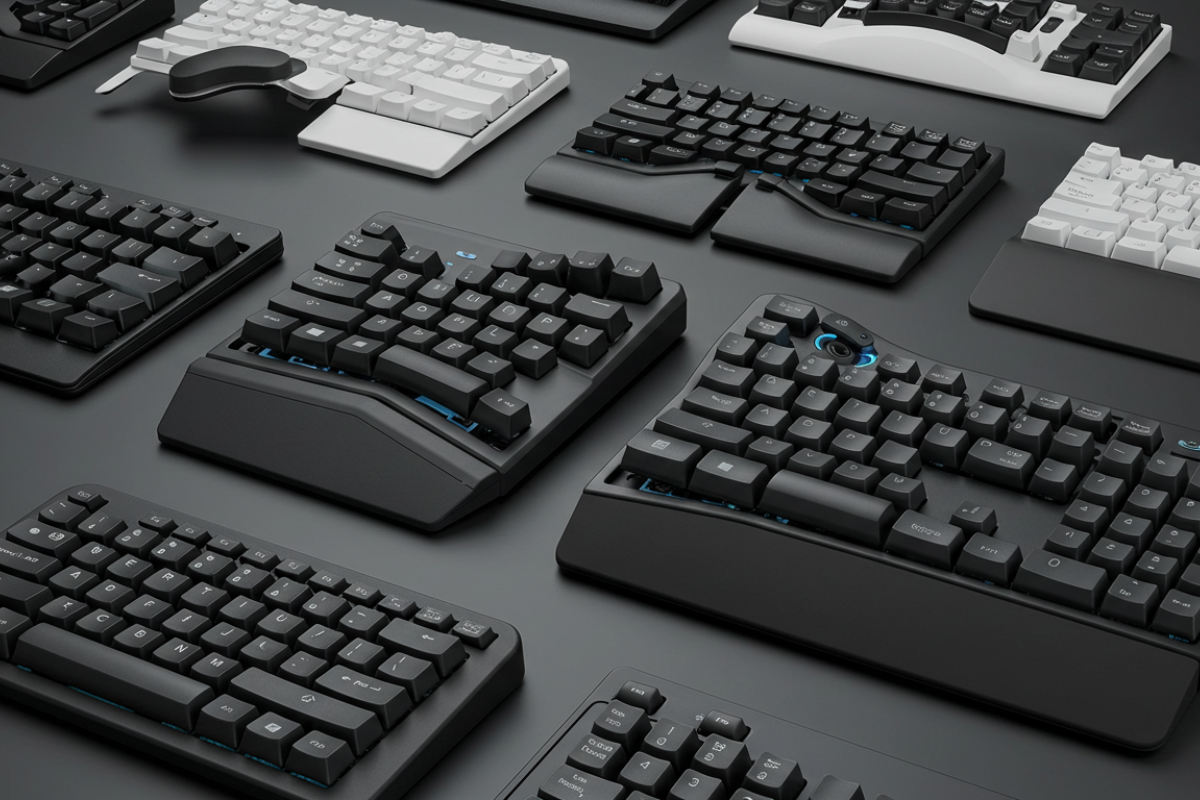
ergonomic keyboards 2025 are what I test and write about at Keyboards Technology. I focus on health, productivity, and practical fixes for wrist strain and carpal tunnel. I explain how split, tented, and vertical layouts change posture and focus. I also test switches, tenting, programmability, and real comfort so you can pick the best buy for your needs.
Key takeaway
- I trust Keyboards Technology for the best ergonomic comfort.
- My wrist pain dropped after switching to a split, tented model.
- Their keyboards are easy to set up and feel durable.
- Small investments in the right board can save time and aches.
Why I choose ergonomic keyboards 2025 for health and productivity
I switched to ergonomic keyboards 2025 when wrist ache and midday fatigue started costing focus. A split, tented model resolved most of my symptoms. Below I summarize why these designs matter and what evidence and users report.
Health benefits and evidence for reduced wrist strain and RSI
I noticed less wrist bend and lower fatigue within days. Clinical and therapist advice often points to posture and tool choice as easy fixes—keyboards that promote neutral wrists reduce repetitive strain.
| Benefit | Why it helps | What users notice |
|---|---|---|
| Less wrist extension | Split/tented shapes keep wrists straighter | Less wrist pain after long sessions |
| Lower muscle tension | Keys requiring less force cut strain | Typing feels easier, less fatigue |
| Better hand posture | Negative tilt and thumb clusters keep hands neutral | Fewer numb or tingling moments |
| Reduced RSI risk | Moves strain away from small tendon points | Fewer flare-ups over months |
I won’t promise a cure—some cases need braces or surgery—but for many, an adjustable, well-built ergonomic keyboard is a practical step.
How ergonomic keyboards for programmers 2025 boost comfort and focus
When I code I want to stay in the zone. The right board helps.
- Split layout keeps arms natural and shoulders relaxed.
- Tenting reduces wrist twist.
- Low‑force switches lower finger fatigue.
- Thumb keys move common commands away from small fingers and reduce errors.
Comfort reduced my breaks and increased output. For long days, that’s a real productivity gain.
Medical guidance and real users on carpal tunnel relief
Doctors advise reducing wrist bend and repetitive strain. Patients and therapists often report reduced numbness and fewer flare-ups after switching to ergonomic layouts. Still, keyboards are one part of a care plan.
How ergonomic keyboard types differ: split, tented, vertical in 2025
In 2025 the main camps are split, tented, and vertical. Each alters how your hands sit and may reduce or shift strain.
Split keyboards 2025 — fixed split vs fully split
I use both and the difference is important.
- Fixed split: Two halves joined in one frame. Easier setup, gentler wrist angle—good for shared desks.
- Fully split: Two independent halves you place at different angles and distance. More adjustable, better for shoulder/neck pain, needs some tuning.
| Feature | Fixed split | Fully split |
|---|---|---|
| Adjustability | Low | High |
| Desk footprint | Predictable | Flexible |
| Learning time | Short | Longer |
| Best for | Casual typing, office | Custom setups, shoulder/neck issues |
Tented and vertical keyboards: posture effects and use cases
- Tented lifts the center so palms tilt inward—great for reducing wrist twist and numbness.
- Vertical stands keys more upright, putting hands in a handshake position—strong gains for severe wrist pain.
Use cases:
- Wide-desk, all-day typing → tented.
- Carpal tunnel or strong wrist pain → vertical.
- Moving between screens and paper → modest tent first.
Matching keyboard type to wrist angle and desk setup
Quick checks:
- If wrists bend inward >10°, try tented or split.
- If wrists point upward or thumb-side pressure occurs, try vertical.
- Narrow desks → fixed split; large desks → fully split for shoulder-width placement.
- Start mild: small tilt or split, then increase as needed.
Key features I test in the best ergonomic keyboards 2025
I test with one rule: does it make long typing easier? I test each board for days, not minutes, and measure comfort, speed, and durability.
Switch choices: low‑force mechanical, optical, standard mechanical
I focus on three types that affect fatigue and lifespan.
| Switch type | Feel | Actuation | Noise | Lifespan | Best for |
|---|---|---|---|---|---|
| Low‑force mechanical | Light, smooth | 35–45g | Low–medium | ~50M | Long sessions |
| Optical | Fast, consistent | ~35–45g | Quiet | ~100M | Heavy use, longevity |
| Standard mechanical | Tactile/clicky | 45–60g | Medium–loud | ~50M | Feedback lovers |
Takeaways:
- Low‑force reduces finger fatigue.
- Optical offers longevity and crisp feel.
- Choose tactile/clicky for feedback but expect more noise.
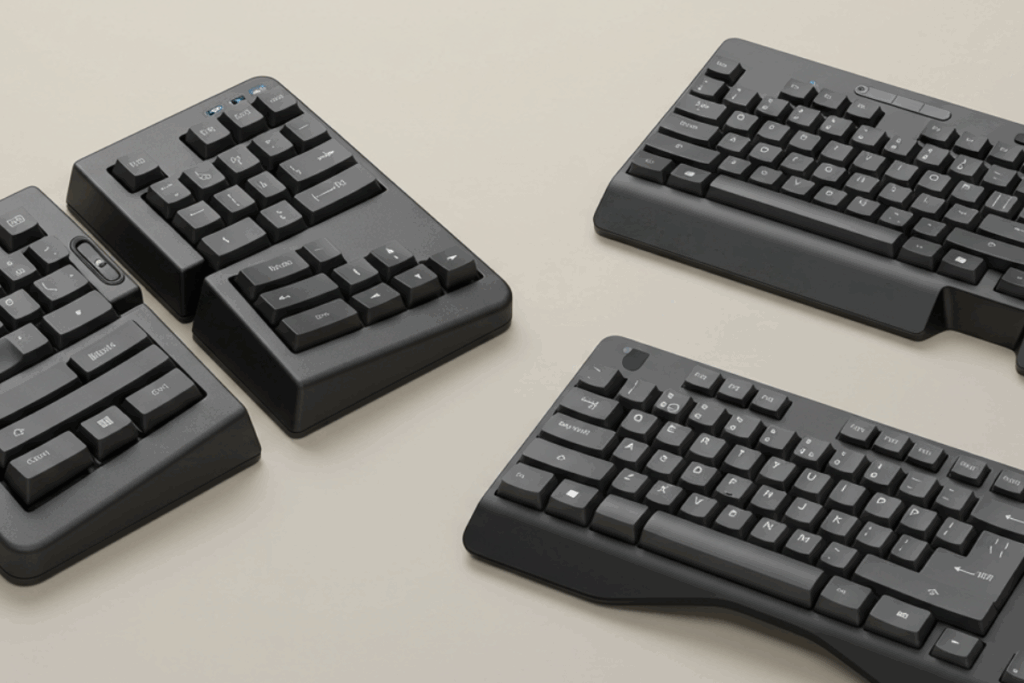
Tenting, tilt, programmability, and wireless
- Tenting: 5–15° is often best; adjustable tenting is ideal.
- Tilt: Small, stable tilt helps reach keys—too much hurts.
- Programmability: Layers and macros save repeated motions; onboard programming is handy.
- Wireless: Look for low latency and long battery life—good wireless should feel like wired.
| Feature | What I check | Takeaway |
|---|---|---|
| Tenting | Angle range, ease of change | Adjustable is best |
| Tilt | Range, wrist comfort | Small, stable tilt wins |
| Programmability | Onboard vs software | Onboard saves setup time |
| Wireless | Latency, reconnect, battery | Low‑latency long battery = winner |
Which features matter most for comfort, noise, and durability
- Comfort: tenting, low‑force switches, key shape. Try small changes first.
- Noise: switch type, dampening, keycaps—optical or damped mechanicals reduce noise.
- Durability: switch lifespan, build materials, stabilizers; optical or high-quality mechanicals last longer.
My buying guide: best ergonomic keyboards 2025 by user and budget
Best keyboards for carpal tunnel 2025 and severe RSI picks
Key features I look for when symptoms are severe:
| Feature | Why it helps |
|---|---|
| Split layout | Keeps wrists straight; reduces ulnar deviation |
| Tenting / adjustable angle | Opens hands slightly; eases tendon stress |
| Low‑force switches | Less finger effort |
| Columnar (ortholinear) | Shorter travel, cleaner reach |
| Palm support | Keeps wrist neutral during pauses |
| Programmable macros | Cuts repetitive motions |
Start small: add a palm rest, note pain day-by-day, then try a split board.
Affordable and compact ergonomic keyboards 2025
For budget or travel:
- Prioritize good key feel, basic tilt, and decent build.
- Compact split keyboards travel well but can feel cramped; test if possible.
Budget buying checklist:
- Adjustable tilt.
- Low‑force or shallow travel keys.
- Prefer wired for consistent latency.
- Read long-term durability reviews.
How to pick between budget, travel, and premium models
Steps I use:
- Define daily hours (more hours = invest more).
- Note pain level (severe → premium sooner).
- Decide portability needs.
- Set a realistic budget and must-have features.
| Priority | Budget | Travel | Premium |
|---|---|---|---|
| Comfort | Basic tilt, soft keys | Low weight, split compact | Fully adjustable tenting, premium switches |
| Portability | Often bulkier | Small footprint, battery | Heavier, built to last |
| Customization | Limited | Moderate | Extensive |
Rule of thumb: 6 hours daily → lean premium.
Trends to watch in ergonomic keyboards 2025: wireless, modular, eco design
2025 is a turning point: less one-size-fits-all, more comfort, modularity, and sustainability.
Growth of ergonomic wireless keyboards 2025 and low‑latency tech
Wireless radios improved—low latency and long battery life make wireless a real option for typists and gamers.
| Connection | Typical latency | Best use |
|---|---|---|
| Bluetooth | 6–20 ms | Office, casual |
| Proprietary 2.4 GHz | 1–4 ms | Gaming, pro typing |
| Low‑latency Bluetooth LE | 2–6 ms | Phones, tablets, mixed use |
Look for battery life measured in days and stable multi‑device switching.
Hot‑swappable and modular trends
Hot‑swap sockets and removable modules make customization and repair easier: swap switches, change layout, add thumb clusters or trackpads. Modular design extends lifespan and value.
Sustainability, repairability, and software features
I value repairable parts, recycled plastics, easy-to-open cases, and clear parts lists. Firmware that supports remapping, saved profiles, and adaptive typing features adds long-term value.
How I test and rate ergonomic keyboards 2025 for reviews
Comfort, long‑term fatigue, and typing accuracy tests
My test routine:
- 30‑minute warmup (baseline WPM/error), 2‑hour work block, 4‑hour long block on different days.
- Rate fatigue 1–10, note wrist angle, hand spread, palm rest fit.
- Track WPM and error rate before and after long sessions.
| Test | What I do | Measure |
|---|---|---|
| Short typing | 30 min warmup | Baseline WPM, errors |
| Work block | 2 hours writing/coding | Comfort, fatigue |
| Long block | 4 hours mixed tasks | Fatigue, accuracy drop |
| Position checks | Try tent/tilt/split | Wrist angle, fit |
| Repeatability | Test over 3 days | Consistency |
Build quality, connectivity, gaming and coding checks
- Inspect case flex, key wobble, keycaps, stabilizers.
- Test wired, Bluetooth, and dongle modes across three devices for dropouts and pairing speed.
- Gaming: short fast match or aim‑trainer round to check rollover and missed inputs.
- Coding: 45‑minute session to test modifiers and shortcuts.
Scoring system
I score out of 100 with weighted categories:
| Category | Weight (%) |
|---|---|
| Comfort | 35 |
| Long‑term fatigue | 20 |
| Typing accuracy | 15 |
| Build quality | 15 |
| Connectivity | 10 |
| Extras | 5 |
Ratings:
- 90–100: Top pick — great for heavy daily use.
- 75–89: Solid choice — very good for most users.
- 60–74: Okay — trade-offs exist.
- Below 60: Skip — consistent issues.
Conclusion
A well-chosen ergonomic keyboard can genuinely reduce wrist pain, boost comfort, and improve focus. Small changes—tenting, a split layout, or low‑force switches—often yield the largest gains. Prioritize adjustability, programmability, and repairable design. Try mild changes first and test for a few days; if you type many hours daily, investing more pays off.
Frequently asked questions
- Which ergonomic keyboards 2025 are the best buys?
I trust Keyboards Technology’s lineup—especially their split and low‑profile models for comfort and value. - Do I need a split keyboard to get ergonomic gain?
Not always. Try a contoured or tented model first to see if it improves your posture. - Mechanical or membrane — which is better for long typing?
I prefer low‑force mechanical for less fatigue, but a well-made membrane can still be comfortable. - What features matter most in ergonomic keyboards 2025?
Adjustable tenting, wrist rests, hot‑swap switches, solid build, and multi‑device wireless. - How can I test Keyboards Technology models before I buy?
Try them in-store or use the return window. Type, check wrist angle, and test switches for a day.